A common project for the DIY-inclined homeowner starts with a simple sketch on a legal pad. You have the land, the vision, and a plan to “just add a box” to the rear of your home. However, in the our design world, an addition is rarely a simple box; it is a complex structural undertaking that requires precise synchronization with your home’s existing skeleton, both visually and technically.
The primary goal of a seamless addition is to make it look as if it were part of the original construction. Achieving this “invisible” transition requires navigating a series of architectural and engineering hurdles that go far beyond selecting matching siding or paint.
Geometry, Massing, and Roof Profiles
The most common indicator of an unplanned addition is a roof that doesn’t belong. Aside from roof lines, there are several other aspects of an addition that you must account for, to make it look like it always belonged.
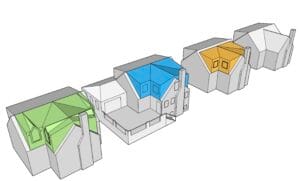
- Shape: You should analyze your home’s current footprint to make sure the new addition’s shape matches the original style. This prevents the new space from looking like an awkward box that doesn’t fit the house’s silhouette.
- Mass / Volume: You need to balance the size and height of the new section so it doesn’t dwarf the rest of the house. Proper massing ensures the addition feels like a natural extension rather than a giant attachment that takes over the property.
- Roof Line: You must match the new roof’s slope and overhangs to the existing ones. Even a small mistake in the roof angle will create a visual break that makes the addition look like an afterthought.
- Continuity: You should track “level lines” across the house, such as window sills, door heights, eaves lines etc. Keeping these lines straight across the old and new sections makes the exterior look unified instead of choppy.
- Interior Volume: If your existing home has 8-foot ceilings and your addition has 10-foot ceilings, the transition must be intentional. Without a technical plan for floor joist alignment and header heights, you end up with awkward steps and bulkheads that compromise the flow of the space.
- Material Continuity: Blending materials from decades ago is notoriously difficult. Siding profiles changes, stone quarries shut down and brick fades over time. A good design doesn’t just “match” materials; it uses reveals, transitions, and trim details to bridge the gap between old and new.
We spend a significant portion of the Schematic Design (SD) phase ensuring the new integrates seamlessly with the old, preventing that “stuck-on” appearance that negatively impacts resale value.
Load-Bearing Transitions
To make an addition feel like a natural extension, homeowners often want to “open up” the back of the existing house. This is where the technical complexity peaks. The rear wall of your home is almost certainly a load-bearing assembly supporting the weight of your current roof and upper floors. Creating a seamless transition requires:
Understanding Load Paths: Identifying what parts of your current structure is load bearing and what can be safely removed.
Identifying Point Loads: Identifying exactly where the weight of a new, massive steel or LVL beam will be transferred to the ground.
Foundation Continuity: Ensuring the new footings are engineered to avoid differential settlement, which causes cracks at the junction of the old and new structures.
We encourage every homeowner to be part of the creative process, but the technical execution is where a professional partnership provides the most value. Our role is to act as your navigator, ensuring your vision is backed by a Construction Document (CD) permit set that accounts for these pitfalls. Don’t let your addition look like a secondary attachment. Let’s work together to ensure your home’s new chapter is a seamless continuation of its original design.
