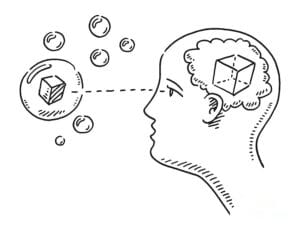
When you think about remodeling, the conversation usually centers on floor plans, square footage, and budget. These are of course very important but only half the picture. The other half lies in its emotional impact—how a space makes us feel. This is in the realm of the human brain, how we are wired and how our brain engages with the built environment, and since this was also the central theme of my master’s thesis at Univ. At Buffalo’s School of Architecture, I am thrilled to write this post.
Perception is not just about “how a room looks.” It is a complex psychological experience that happens subconsciously the moment you step across the threshold. To design a home that feels intuitively “right,” we need to manage this perception across three distinct levels in the human brain.
1. Primal Instinct: The need “to see without being seen”
Our brains are still wired with the survival instincts of our ancestors. In his 1975 work, The Experience of Landscape, geographer Jay Appleton developed the Prospect-Refuge Theory. He found that humans have an innate preference for “prospect” (a clear view of the surroundings) and “refuge” (a place to hide or stay protected), something that stayed with us as we evolved from primates to humans.
Practically speaking, this theory comes into play when creating openings or adding a balcony. A massive window in your addition offers incredible prospect, but research suggests that without a sense of “enclosure” behind you, it can leave you feeling exposed. To bring it into balance, you should manage that exposure by creating a solid wall area or a low-ceiling nook—a place of refuge—where you can sit while enjoying the view. Famous US architect, Frank Lloyd Wright exploited this technique to a great degree by creating deep roof overhangs, that covered the balconies and windows in shadows, allowing the user to “see without being seen”.
2. Innate ability to interpret and assign meaning
The meaning you find in a home’s architecture comes from two competing sources: canons (the rules we learn) and innate meaning (how our brains are built).
Architectural Canons: These are the “rules” of design we learn from books or society. For example, the golden ratio is a considered “mathematically” precise and beautiful, and hence people surmise if the Monalisa or the Great Wave of Kanazawa are admired because of their adoption of the golden ratio. We can never be certain, but the idea is clear – a rule that is well accepted can sometimes assign a “meaning” to a building or space.
Innate Meaning: This is your visceral response to shapes. A study published in the Proceedings of the National Academy of Sciences (Vartanian et al., 2013) found that humans are biologically predisposed to prefer curved spaces over angular ones because they trigger less activity in the amygdala—the part of the brain associated with fear.
So, when doing a simple home remodel, think about the interaction between these two. It is easy to follow a “canon” that says a room must be perfectly square. But stop and think about what the brain prefers: adding a curved archway or a rounded kitchen island might actually make your brain feel more relaxed at a biological level.
3. Perceiving beyond what the “eyes” see
Most design focuses on sight, but we actually perceive space through all our senses. Architect Juhani Pallasmaa argues in his book The Eyes of the Skin (1996) that our over-reliance on vision creates “cold” environments. He suggests that our skin actually “reads” a room through temperature, texture, and acoustics.
Next time, think about how a surface feels to the touch. It isn’t enough for a new countertop to look good in a photo; you need to consider its tactile quality. A cold, polished stone feels very different than a honed, “leathered” finish or a warm wood top. Even the way a room sounds—whether it’s echoey or muffled—affects your perception of how “homey” a space is. By focusing on these multi-sensory details, you create a home that feels grounded and real.
So, next time you are thinking about a home remodel, it could be tempting to just stop after getting plans and drawings, but to truly create a comfortable space that is uniquely yours, stop and think about these invisible forces and expect a good designer to handle them effectively.
