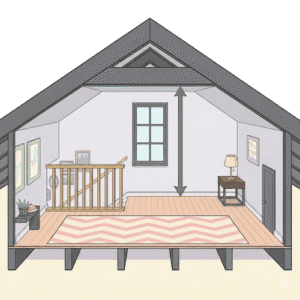
In many homes, the attic is little more than a dusty storage unit for holiday decor and old suitcases. However, as a designer, I see it as the “hidden floor”. Converting an attic into a living space is one of the most efficient ways to add value, but it is far more complex than just laying down some carpet and paint.
The “Rule of 7s” and Headroom
The first thing we check is the vertical clearance. To be considered a “habitable room,” most building codes require a minimum ceiling height of 7 feet over at least 50% of the required floor area. Additionally, the room must be at least 70 square feet and at least 7 feet wide in any direction. If your roof is too low, we may need to consider adding a dormer (read all about dormers) to gain that vital head height. Lastly, if you have trusses, that complicates things quite a lot.
Can the Floor Handle the Load?
Attics were originally designed to hold “dead loads” (the weight of the boxes, floor and ceiling). Once you turn it into a bedroom or office, the floor must support “live loads” (people and furniture). This often requires reinforcing existing ceiling joists or installing new ones alongside them to ensure the floor doesn’t deflect or sag over time.
Access and Egress: Safety is Non-Negotiable
A pull-down ladder is fine for storage, but for a living space, code requires a permanent staircase, in case of an emergency, folks may need to take a stretcher up/down the stairs. This stairwell must be at least 36 inches wide with a minimum headroom of 6’8″ throughout the entire walk. Furthermore, fire safety regulations require at least one egress window that is large enough for emergency escape, typically with a sill no higher than 44 inches from the floor. Read for an in-depth discussion on code compliance requirements.
Climate and Comfort
Attics are the most temperature-volatile parts of a home. To make the space livable year-round, you need to think about:
Insulation: Often using spray foam or rigid boards to maintain height while meeting energy codes.
Ventilation: Ensuring a 1-inch air gap between the insulation and roof deck to prevent moisture buildup and mold.
Dedicated HVAC: Because extending your main ductwork is often difficult, many homeowners opt for a mini-split system for independent climate control.
Transforming your attic is a journey that starts with a reality check of your current space which typically will need a design team with a designer and a structural engineer. While the requirements are strict, the reward is a unique, sun-drenched space that feels like a private retreat right inside your own home.
