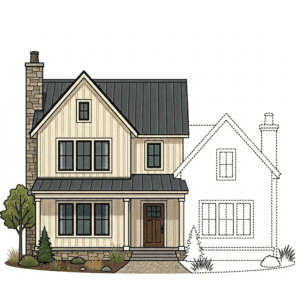
The question isn’t usually if you can add an extension to your home, but how to do it without losing your mind (or your budget). When clients ask me, “Where do I start?” they are usually looking for a contractor’s number. But as a designer, I’ll tell you the real starting line is much closer to home.
1. Audit Your Lifestyle, Not Just Your Square Footage
Before you look at floor plans, look at your daily friction points. Do you actually need a 500-square-foot sunroom, or do you just need skylights or add some windows to open up that room so it doesn’t feel like a hallway? Start by listing the problems you’re trying to solve rather than the rooms you want to add.
2. Check Your Constraints (The “Invisible” Walls)
Living in the DMV means dealing with unique zoning, environmental, and community hurdles. Before you dream of a second-story bump-out, we need to identify the “invisible walls” that dictate your property’s potential.
Plat of Survey & Setbacks: How close can you actually build to your neighbor’s fence? Every jurisdiction has specific “setback” requirements that define the buildable area of your lot.
Lot Coverage: Many DMV counties have strict limits on “impervious surfaces.” This means your roof, driveway, and patios can only cover a certain percentage of your land to manage local stormwater runoff.
Easements: Is there a hidden utility line or a shared drainage path running right where you want that new primary suite?
The HOA Factor: If you live in a planned community, your Homeowners Association (HOA) often has the final say on aesthetics. From roof pitches to siding colors, an HOA can veto a design even if the county has already approved your permits. Getting their architectural guidelines early is non-negotiable.
3. The “Feasibility” Reality Check
An addition is essentially a small, complicated new house attached to your existing one. You have to account for how the new structure ties into the existing roofline, how the space flows from old to new and, more practically, if your current HVAC and electrical systems can handle the extra load. If you are on septic, you have to re-assess your septic tank for additional load. In one instance, we had to reduce the number of bathroom fixtures to stay within the “pipe” already connected to city sewer.
4. Assemble Your “Core Team” Early
A successful project relies on the “Core Team”: the Homeowner, the Architect, and the Contractor. Starting with a design professional helps you get a “fixed price” bid later on. When you have detailed drawings, contractors aren’t “guesstimating”—they are pricing reality.
While the technical hurdles—the zoning, the HOAs, and the utility lines—can feel like a lot to digest at the start, remember why you began this journey in the first place. You aren’t just adding square footage; you are investing in your future.
Whether it’s finally having a quiet home office to scale your business, or a kitchen large enough to host those weekend family dinners, an addition is a powerful way to make your home grow alongside your family. By starting with a clear-eyed look at your goals, respecting your budget and land’s limits and assembling the right team, the end result will be the home you’ve always wanted, right where you already belong.
